



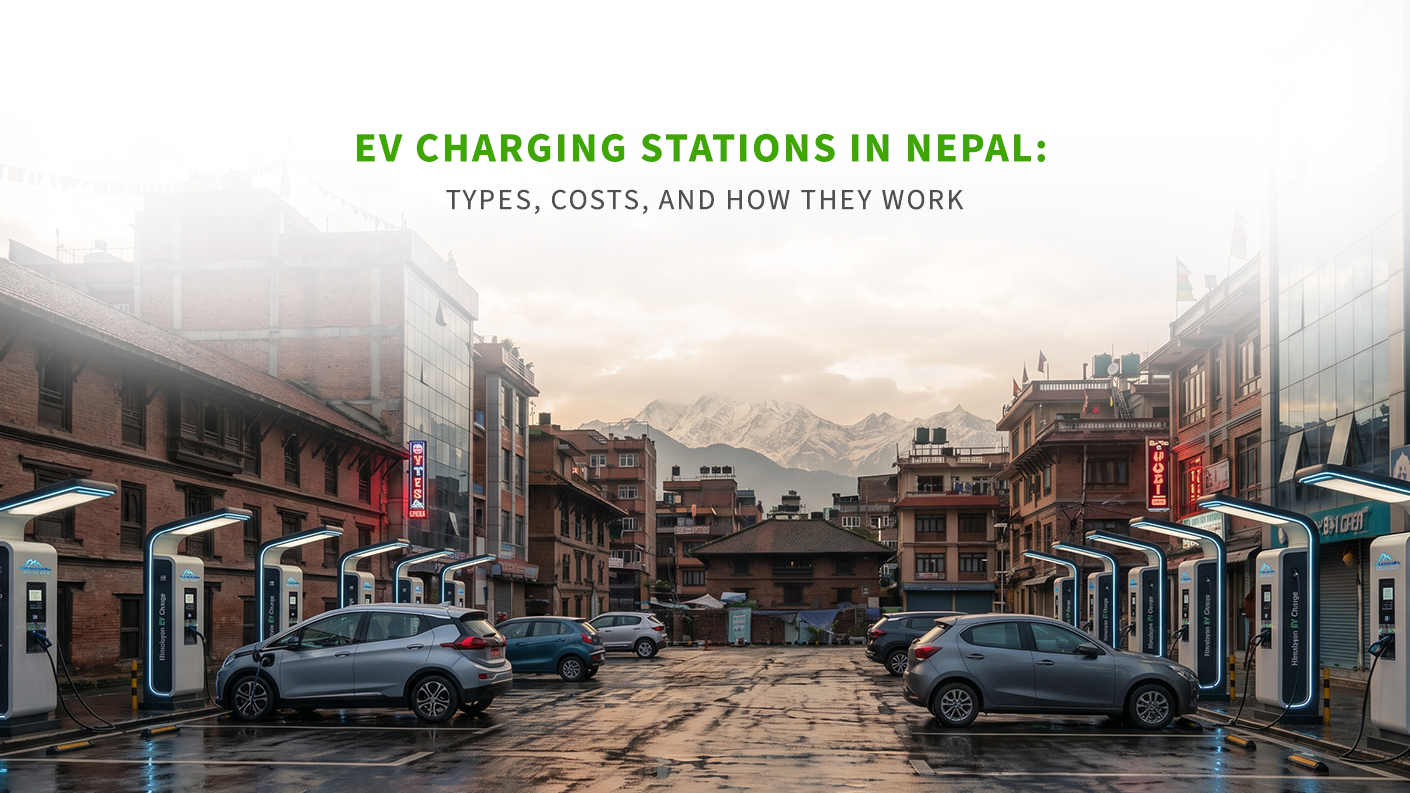
Electric vehicles (EVs) are becoming more popular in Nepal. With rising fuel prices and a push for clean energy, many people are switching to electric cars and bikes. But one common question remains: how do EV charging stations in Nepal work, and what do they cost?
In this guide, you’ll learn everything in simple terms, from types of chargers to costs and future trends.
Nepal’s EV Revolution Is Already Here
Nepal is not slowly moving toward electric vehicles; it has already leaped. Between 2020 and 2025, four-wheel EV registrations jumped from roughly 1,255 units to over 11,700 in a single year. Today, Nepal has more than 1,200 public and private EV charging stations across the country, up from fewer than 50 in 2020. That is extraordinary growth for any market, let alone one in South Asia.
The reason is simple: Nepal generates over 90% of its electricity from hydropower. That means charging your car here is not just cheaper, it is genuinely cleaner than almost anywhere else in the world. Add rising petrol prices, government import incentives, and increasingly affordable EV models like the Dongfeng Nammi Box, and you have every reason to make the switch.
But none of that matters if you do not understand how EV charging stations in Nepal actually work. So let us break it down.
The Three Types of Electric Vehicle(EV) Charging Stations in Nepal
Not all Electric Vehicle charging stations in Nepal are the same. They fall into three main categories based on charging speed, and choosing the right one depends on your vehicle, your schedule, and where you are.
1. Slow AC Charging (Home / Level 1 Charging)
This is the most common way EV owners in Nepal charge their vehicles. You plug your car into a standard 220V household socket, and it charges overnight. It typically adds around 6 to 10 km of range per hour, which is more than enough if you drive a normal daily route.
The cost is low because you are using NEA’s residential electricity tariff, which runs at approximately NPR 10–12 per unit (kWh). A full charge for a car with a 30–40 kWh battery will cost you roughly NPR 300–480 at home less than a single ride in a petrol-powered cab for the same distance.
If you want to charge faster at home, you can install a dedicated wallbox charger (7 kW). The installation typically costs between NPR 30,000 and NPR 60,000 as a one-time expense, and it cuts your overnight charging time in half.
2. AC Fast Charging (Public Stations / Level 2 Charging)
These are the chargers you find at shopping malls, hotels, dealerships, and commercial parking areas in Kathmandu, Pokhara, and Chitwan. They deliver 7 kW to 22 kW of power and can charge most EVs in 4 to 8 hours.
Nepal Electricity Authority (NEA) public stations charge under a transportation tariff, generally ranging from NPR 6–11 per kWh depending on the time of day. Off-peak hours (roughly 10 PM to 5 AM) tend to be cheaper. Private operators at malls or commercial plazas may charge slightly more usually NPR 12–18 per kWh but they offer the convenience of charging while you shop or work.
3. DC Fast Charging (Highway / Rapid Chargers)
This is where things get impressive. DC fast chargers skip your car’s onboard converter entirely and push power directly into the battery. A 50 kW to 150 kW fast charger can bring most EVs from 20% to 80% battery in just 30 to 60 minutes.
These chargers are the backbone of long-distance EV travel in Nepal. NEA has already installed 62 fast-charging hubs across the country, with more planned along the Kathmandu–Pokhara and Kathmandu–Chitwan corridors. Each NEA fast-charging hub includes 60/60 kW DC chargers and 22 kW AC chargers.
The cost at DC fast chargers runs between NPR 15–20 per kWh at private stations. That makes a full charge cost roughly NPR 600–900 for a typical 40–50 kWh battery, still far cheaper than filling a petrol tank for the same range.
How Does an Electric Vehicle(EV) Charging Station Actually Work?
If you have never used a public EV charging station in Nepal, the process can seem a little unfamiliar. But it is actually simpler than it looks.
You start by locating a station using Google Maps, the ChargeShop app, or EV Nepal’s platform. When you arrive, you either tap an RFID card, scan a QR code, or use the operator’s mobile app to start your session. Some older stations simply require you to plug in and wait.
Once connected, the charger communicates with your car’s Battery Management System (BMS). Think of the BMS as your battery’s bodyguard; it monitors temperature, voltage, and charge level constantly. It tells the charger exactly how much power to send, and it slows things down automatically as your battery approaches full to protect battery health. This is why DC fast charging slows noticeably after 80%. It is not a malfunction; it is the system protecting your investment.
When your session ends, the system tallies the kWh consumed and deducts the amount from your prepaid wallet or mobile banking account. Simple, transparent, and increasingly seamless.
What’s the EV charging cost in Nepal? A Real-World Comparison
Let us put real numbers to it. Imagine you drive 30 km a day, every day, for a month, that is 900 km.
In a petrol car, at around NPR 12–15 per km, you would spend roughly NPR 10,800–13,500 a month just on fuel. That does not include engine oil changes, filter replacements, or the other maintenance items petrol vehicles need regularly.
In an electric car charged at home, at roughly NPR 2–3 per km, that same 900 km costs you approximately NPR 1,800–2,700. Even if you rely exclusively on public DC fast chargers at NPR 5–7 per km, you are still looking at NPR 4,500–6,300 half the petrol bill or less.
Over a year, the savings are in the lakhs. Over five years, they can pay for a significant portion of the vehicle itself.
This is precisely why models like the Dongfeng Nammi Vigo, despite having a higher upfront price than a basic petrol car, make strong financial sense for Nepali families who drive regularly.
Government Support Is Making It Easier
Nepal’s government has put real weight behind EV charging infrastructure. In 2023, NEA inaugurated 51 new charging stations across all seven provinces including 26 stations equipped to charge buses, trucks, and cars at the same time. Each station was installed with a 142 kW charger, a 50 kVA power transformer, and an online charging management system.
The government has also revised NEA’s distribution bylaws to allow private companies to install charging stations inside commercial buildings and public spaces. This has opened the door for shopping malls, apartment complexes, and business parks to offer EV charging as a standard facility much like parking itself.
For individual EV owners, reduced customs duty on electric vehicles (as low as 1–10% compared to 80%+ on petrol cars) continues to lower the purchase price. Banks, encouraged by Nepal Rastra Bank directives, have begun offering EV-specific loans at competitive interest rates. Nepal’s stated goal is to have 25% of all transport running on electricity by 2030.
Conclusion
Electric Vehicle(EV) charging stations in Nepal are growing quickly, making it easier than ever to own an electric vehicle. The EV charging cost savings are real. The environmental benefit of running on Nepal’s hydroelectric power is real. And the infrastructure, while not yet perfect, is expanding rapidly enough that buying an EV today means growing into a better charging network over time, not waiting for one.
The future is electric. In Nepal, that future is powered by the Himalayas.
FAQs
1. How many EV charging stations are there in Nepal?
As of 2025, Nepal has over 1,200 public and private EV charging stations across the country. The Nepal Electricity Authority (NEA) alone operates more than 62 fast-charging hubs, with hundreds more run by private operators at malls, hotels, and dealerships.
2. How much does it cost to charge an EV at home in Nepal?
At home, you pay NEA’s residential electricity rate of roughly NPR 10–12 per unit (kWh). A full charge for a typical 30–40 kWh battery costs around NPR 300–480, far cheaper than a full tank of petrol for the same distance.
3. How long does it take to fully charge an electric car in Nepal?
It depends on the charger type. A standard home socket takes 8–12 hours for a full charge. A public AC fast charger (7–22 kW) takes around 4–8 hours. A DC fast charger can bring your battery from 20% to 80% in just 30 to 60 minutes.
4. What is EV charging cost in Nepal?
NEA public stations bill at NPR 6–11 per kWh, while private fast chargers can go up to NPR 15–20 per kWh.
0 Comments