



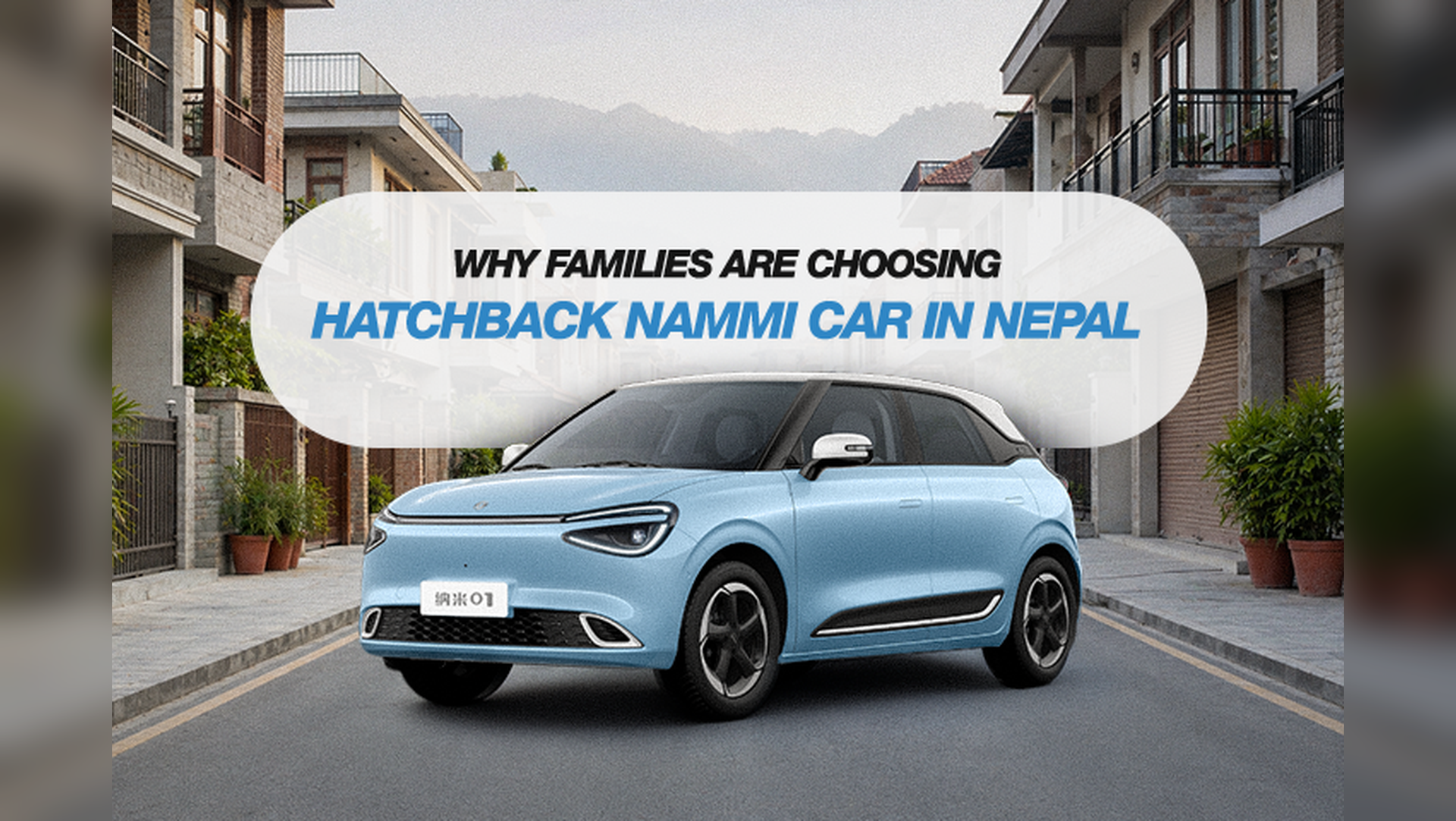
Planning a drive from Kathmandu to Pokhara with five people and a full boot used to mean either squeezing into a small petrol hatchback or stretching the budget for a larger SUV. Today, Nepali families are finding a third option and it runs on electricity.
The family hatchback market in Nepal is shifting. Parents are asking harder questions before buying: Can this car genuinely seat five adults? Will it cover 300 kilometres without a charging stop? Is it safe enough for the Kathmandu ring road at school-rush hour?
This blog works through those questions honestly. It looks at why electric hatchbacks are gaining ground with families in Nepal, what the Nammi Box actually offers in real-world driving conditions, and what you should check before making a decision.
Why Electric Hatchbacks Are Becoming the First Choice for Families in Nepal
The shift toward electric vehicles among Nepali families is not driven by trend-following. It comes down to three practical realities: fuel costs, road conditions, and long-term ownership economics.
The Real Cost of Running a Petrol Hatchback in 2025
A typical Kathmandu family driving 50–60 km per day on petrol spends approximately NPR 12,000–15,000 on fuel monthly. A comparable EV covering the same distance costs a fraction of that in electricity, especially with overnight home charging on Nepal’s domestic tariff rates.
Beyond fuel, servicing costs differ significantly. Petrol engines require regular oil changes, air filter replacements, timing belt maintenance, and coolant flushes. EVs eliminate most of these. Families switching to electric typically report a noticeable drop in monthly ownership costs within the first six months.
How Nepal’s Charging Infrastructure Has Changed the Equation
Two years ago, range anxiety was a genuine barrier for Nepali EV buyers. That calculation has changed.
Charging stations are now available across Kathmandu Valley, along the Prithvi Highway toward Pokhara, and at key stops on the Narayangadh–Butwal corridor. Major fuel stations in cities like Pokhara, Bharatpur, and Birgunj have added EV charging points.
For most families, the more relevant fact is simpler: a home charging setup means the car starts every morning with a full charge. Daily city driving rarely exceeds 80–100 km, which is well within the comfortable range of any current affordable family EV in Nepal.
What Government Policy Means for EV Buyers Right Now
Nepal’s government has maintained lower import duties on electric vehicles compared to petrol cars, which has a direct impact on the showroom price gap between EVs and petrol equivalents.
A well-specced EV family hatchback can now sit in a similar price bracket to a mid-range petrol MPV with lower running costs from day one. Families who factor in total cost of ownership over five years, rather than just the sticker price, are increasingly finding EVs make more financial sense.
The Space Question: Can a Hatchback Fit a Full Family Comfortably?
The honest answer depends entirely on which hatchback you are comparing. Not all hatchbacks are built to the same interior dimensions, and the difference between a car that fits four comfortably and one that genuinely fits five shows up immediately on a long drive.
Seating That Actually Works for Five
The Nammi Box is wider and longer than most hatchbacks in its segment. That matters because shoulder room and rear legroom, the two areas where most five-seat hatchbacks compromise are the first thing passengers notice on trips longer than forty minutes.
Three adults in the back row should not require an apology from the driver. Headroom on long routes to Daman or the Terai should not be a conversation topic. A family hatchback earns that description by delivering on those basics before anything else.
Boot Space for Real Family Life
The Nammi Box offers 945 litres of boot space, a number that only becomes meaningful when you load it.
A school run kit, a weekly grocery haul from Bhatbhateni, a stroller, or a full set of luggage for a Pokhara long weekend: all of it fits, without rearranging. For comparison, most petrol hatchbacks in the same price range offer between 300 and 450 litres. Families who have driven both notice the difference on their first trip with everyone packed.
Small Thoughtful Features That Make Long Drives Easier
Two features of the Nammi Box tend to get mentioned by parents more than any spec sheet item.
The first is the passenger-side drawer with a fold-out tabletop. On a three-hour drive to Chitwan with young children, having a stable surface for snacks, tablets, or activity books removes a consistent source of backseat chaos.
The second is the baby care mode AC, a ventilation setting that delivers filtered, gentler airflow to rear passengers. For families with infants or young children who are sensitive to strong AC, this is the kind of detail that gets remembered.
How Does the Nammi Box Handle Safety on Nepal’s Roads?
Safety considerations for a family hatchback in Nepal are shaped by two distinct environments: urban Kathmandu traffic, and the open but variable conditions of inter-city highways.
Navigating Kathmandu Traffic
Kathmandu’s roads combine narrow lanes, dense pedestrian movement, and unpredictable merging. The Nammi Box addresses this with a 360-degree camera system supported by 12 ultrasonic radars.
In practical terms, this means the car detects objects in blind zones while reversing, provides a full overhead view during parking in tight lanes, and gives the driver a clearer picture of surrounding conditions than mirrors alone can offer. For parents managing Thamel-level traffic with children in the car, this is less of a premium feature and more of a daily tool.
Highway and Long-Route Safety
Level 2 ADAS Advanced Driver Assistance Systems until recently appeared only in vehicles costing significantly more than any family hatchback EV available in Nepal.
The Nammi Box includes adaptive cruise control, automatic emergency braking, and lane keeping assist as standard. On the Prithvi Highway or the Kathmandu–Hetauda road, these systems provide an additional layer of attention when driver fatigue is a real factor on longer trips. The car does not replace the driver but it monitors conditions continuously and intervenes when a collision risk is detected.
Cabin Safety for Young Passengers
Heated and ventilated seats ensure that passengers including elderly family members who may be more temperature-sensitive are comfortable regardless of the season. January mornings in Kathmandu and June afternoons in the Terai require very different responses from a climate system, and the Nammi Box handles both.
Is the Nammi Box a Practical Long-Distance Family Car?
This is the question most Nepali families ask second, right after interior space.
Real-World Range vs Nepal’s Most Common Family Routes
The Nammi Box delivers over 300 km of real-world range on a full charge. Against the routes that matter to most Nepali families:
- Kathmandu to Pokhara: approximately 200 km
- Kathmandu to Chitwan (Bharatpur): approximately 145 km
- Kathmandu to Daman: approximately 70 km
- Kathmandu to Hetauda: approximately 85 km
Every one of these routes is comfortably within a single charge, with range to spare for driving within the destination city. Trips that used to be a “maybe” become a straightforward yes.
What Happens When You Charge at Home Overnight
A family doing 40–80 km per day in Kathmandu can charge at home overnight, wake up to a full battery, and never think about range during the working week.
Unlike a petrol car that requires periodic fuel station visits, a home-charged EV fits into the existing routine without adding a step. Most families report that within a few weeks of ownership, the charging habit becomes invisible like plugging in a phone before bed.
What Makes the Nammi Box the Affordable Family EV Choice in Nepal?
Price is not just the sticker figure. For a family, the more relevant question is what this car costs to own over three, five, or ten years.
Monthly Running Costs vs a Comparable Petrol Hatchback
The electricity cost to cover 1,500 km per month in the Nammi Box is significantly lower than the petrol cost for the same distance in a comparable ICE hatchback. Servicing intervals are longer and the list of consumable parts is shorter.
Families who have made the switch consistently describe the monthly saving as meaningful not dramatic in a single month, but compounding steadily over a year.
What an 11-Year Warranty Actually Means for a Family
Dongfeng Nepal offers an 8-year / 200,000 km standard battery and motor warranty on the Nammi Box. Through the MAW Vriddhi Extended Warranty Program in partnership with Shikhar Insurance, this can be extended to 11 years / 250,000 km.
For a family making a significant purchase decision, that warranty horizon matters. It means the most expensive components of the car the battery and motor are covered for as long as most families own the same vehicle. The extended warranty requires continuous insurance coverage with Shikhar Insurance to remain valid. Full terms are available on the Dongfeng Nepal Extended Warranty page.
Features You Would Pay a Premium For Elsewhere
Heated and ventilated seats, a 13-inch floating touchscreen, 32-colour ambient lighting, Level 2 ADAS, and a 360-degree camera system are features that appear in vehicles priced significantly higher in the petrol market. As an affordable family EV in Nepal, the Nammi Box brings them into a price range that a wider range of families can realistically consider.
The value density what you get per rupee is one of the clearest arguments the car makes for itself.
Conclusion
The reasons Nepali families are choosing a family hatchback EV come down to the same things they have always cared about: space, safety, reliability, and cost.
What has changed is that the best family hatchback EV options in Nepal now deliver on all four in the same package. Lower monthly running costs, genuine five-seat comfort, inter-city range that covers the routes families actually drive, and safety systems that were previously available only in premium vehicles the Nammi Box brings these together at a price point that makes the decision practical rather than aspirational.
If you are evaluating whether an electric hatchback makes sense for your family, the most useful next step is to see the boot space in person and sit in the rear seat. Numbers on a spec sheet only go so far.
Explore the Nammi Box | Book a Test Drive
Frequently Asked Questions
1. Is a hatchback EV practical for a family of five in Nepal?
Yes, provided you choose a model with genuine five-seat dimensions. The Nammi Box is built wider and longer than standard hatchbacks in its segment, with enough legroom and shoulder room for five adult passengers on long drives.
2. How far can the Nammi Box travel on a single charge?
The Nammi Box delivers 300+ km of real-world range, covering all common Nepali family routes Pokhara, Chitwan, Daman, and Hetauda on a single charge.
3. What is the boot space of the Nammi Box?
945 litres. This comfortably handles school bags, a full weekly grocery run, travel luggage for four to five people, and a stroller.
4. Does the extended warranty require a specific insurance company?
Yes. The MAW Vriddhi Extended Warranty requires continuous comprehensive motor insurance with Shikhar Insurance for the full warranty period. If the insurance is changed, the extended warranty is terminated. Full details are at dongfengnepal.com/extended-warranty/.
5. What safety features does the Nammi Box offer for Nepal’s roads?
The Nammi Box includes a 360-degree camera with 12 ultrasonic radars, Level 2 ADAS (adaptive cruise control, automatic emergency braking, lane keeping assist), and baby care mode AC for rear-passenger comfort.
0 Comments