



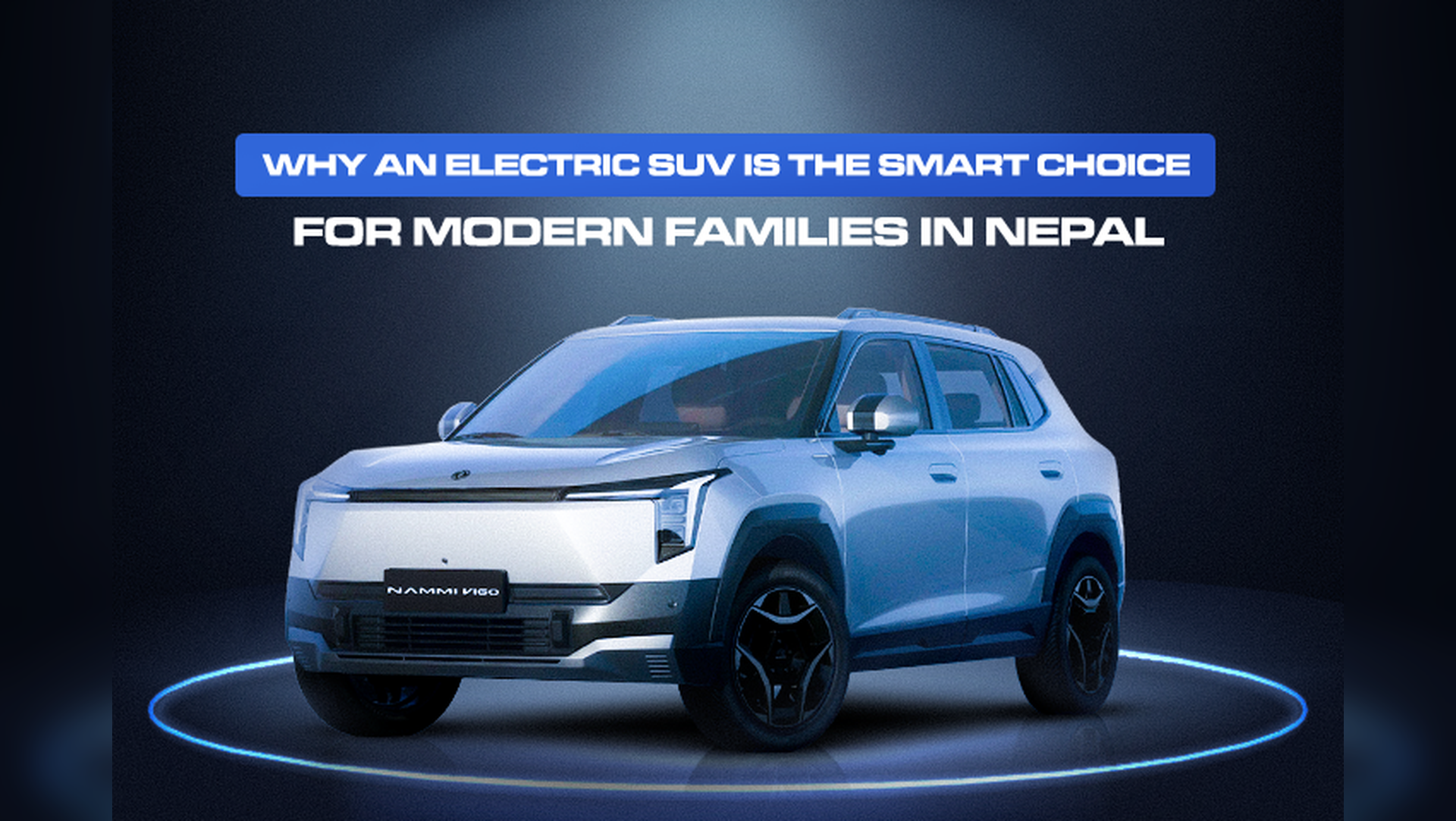
Every morning, thousands of families across Kathmandu, Pokhara, and Chitwan face the same routine school drop-offs, office commutes, grocery runs, and the occasional weekend escape to the hills. Add rising fuel prices and increasingly congested roads, and it’s no surprise that more households are asking the same question: is an electric SUV actually a practical choice for everyday family life in Nepal, or just a trend?
This article breaks down what really matters range, charging, safety, space, and running costs so you can decide with facts, not hype.
Why Families Are Increasingly Considering an Electric SUV
Nepal’s EV market has grown sharply over the past few years, with four-wheel electric vehicle registrations climbing into the thousands annually as more affordable models entered the market. SUVs, in particular, have become a favourite body style because they offer the seating flexibility, ground clearance, and cargo room that growing families actually need.
For households juggling school runs, weekend trips, and the occasional rough patch of road outside the city, an electric SUV brings together two things families value most: practicality and lower running costs.
Electric SUV Range: What Families in Nepal Should Realistically Expect
One of the first questions every family asks is about electric SUV range and rightly so. Range determines how often you’ll need to plan around charging, especially on longer drives to places like Pokhara, Chitwan, or the hill stations around the valley.
Most electric SUVs list a range figure based on standardized testing (such as CLTC or WLTP cycles), but real-world driving in Nepal often looks different:
- Hilly terrain increases energy consumption on the way up and can partially recover it on the way down through regenerative braking.
- Air conditioning and heating can reduce range by a noticeable margin, especially during Kathmandu’s colder winter mornings.
- Passenger load and luggage a full SUV with five passengers and luggage for a weekend trip will use more energy than a single commuter.
- Driving style and frequent stop-and-go city traffic can actually be more efficient for EVs than constant highway speeds, thanks to regenerative braking.
Practical tip: When comparing electric SUV range figures between models, look for real-world or “city range” estimates where available, and calculate your typical weekly mileage first. Most families significantly overestimate how much range they actually need for daily use a school and office commute rarely exceeds 40–60 km a day.
Charging an Electric SUV in Nepal: Home, Highway, and Everyday Life
A few years ago, charging access was the biggest concern for anyone considering an electric SUV in Nepal. That picture has changed quickly.
Home charging remains the most convenient option for families. A standard home charging setup, usually installed in a garage or parking space, can fully charge most electric SUVs overnight meaning you start every day with a full battery, much like charging a phone.
Public charging infrastructure has expanded considerably as well. The Nepal Electricity Authority and private companies have been installing fast chargers along major routes, including the East-West Highway and Prithvi Highway, with government strategy documents targeting a significant nationwide expansion of charging stations over the coming years. If you’re curious about how this infrastructure is being built out, our detailed guide on starting an EV charging station business in Nepal covers the current landscape in depth.
Fast charging on the road means a stop for tea or lunch can also top up your battery significantly turning what used to feel like “downtime” into a natural part of the journey.
Safety Features That Matter When You’re Driving With Family
Picture this: a Friday evening drive back from Bhaktapur with the kids asleep in the back seat, headlights of oncoming traffic, and a narrow stretch of road ahead. This is exactly the kind of scenario where modern safety technology earns its place in a family vehicle.
Many newer electric SUVs now come equipped with driver-assistance features that were once reserved for luxury cars:
- Adaptive cruise control maintains a safe following distance automatically on highways.
- Lane-keeping assist gently corrects steering if the vehicle drifts.
- Automatic emergency braking can react faster than a human driver in sudden stop situations.
- 360-degree camera systems make tight parking and narrow lanes far less stressful particularly useful in older neighbourhoods with tight turns.
For families, these aren’t just “nice to have” extras. They reduce driver fatigue on long trips and add a meaningful layer of protection during everyday city driving.
Space, Comfort, and Everyday Practicality
Beyond the technology, an electric SUV needs to work for real life car seats, school bags, sports equipment, and the occasional trip to the hardware store.
Most electric SUVs offer:
- Flexible seating configurations that adjust for passengers or cargo depending on the day.
- Generous boot space, often larger than equivalent petrol SUVs since EV powertrains free up space typically used for engine components.
- Higher ground clearance, which matters on Nepal’s mix of paved roads, monsoon-affected stretches, and semi-urban lanes.
- Quieter cabins, since electric motors produce far less noise and vibration than combustion engines a small but noticeable difference on long drives with young children.
Running Costs: Electric SUV vs. Petrol SUV
This is often where the decision becomes clearest for families watching their monthly budgets.
Electricity costs significantly less per kilometre than petrol or diesel in Nepal estimates suggest savings of roughly NPR 10–15 per km depending on electricity tariffs and vehicle efficiency. Over a year of regular driving, that difference adds up substantially.
Maintenance costs also tend to be lower. Electric SUVs don’t require engine oil changes, spark plug replacements, or exhaust system repairs, since there’s no combustion engine to maintain. Government policy has also played a role, with reduced customs duties and tax incentives making electric vehicles more price-competitive in Nepal’s market over recent years.
Things to Check Before Choosing an Electric SUV in Nepal
Before making a decision, it helps to go through a simple checklist:
- Map your real driving needs daily commute distance, weekend trip frequency, and typical passenger load.
- Check charging access is home charging possible where you live, and how far is the nearest public charger on routes you frequently travel?
- Compare electric SUV range under realistic conditions, not just headline figures.
- Look at safety features relevant to your family’s driving habits: highway driving, city parking, or both.
- Factor in total cost of ownership, not just the purchase price, electricity costs, maintenance, and resale considerations all matter long-term.
If you’re also exploring current pricing across the market, our updated guide to EV car prices in Nepal for 2026 is a useful starting point for comparison.
Conclusion
Choosing an electric SUV isn’t just about following a trend for many families in Nepal, it’s becoming a practical response to rising fuel costs, improving charging infrastructure, and a genuine need for safer, more spacious vehicles that fit everyday life. Range, charging access, and total running costs are the three factors worth researching most carefully before you decide.
If you’re currently comparing options, take some time to explore the Dongfeng Vigo to see how their specifications match up against your family’s daily routine. And if this guide helped clarify things, feel free to share it with someone else who’s weighing the same decision or drop your questions in the comments below.
Frequently Asked Questions
What is a realistic electric SUV range for Nepal’s roads?
It depends on the model, but most families should focus on real-world range under mixed driving conditions (hills, AC use, passenger load) rather than the maximum advertised figure.
Is charging an electric SUV difficult in Nepal?
Not anymore for most urban and semi-urban areas. Home charging covers daily needs, while public fast-charging networks continue to expand along major highways.
Are electric SUVs safe for long family road trips?
Many models now include driver-assistance features like adaptive cruise control and automatic emergency braking, which can reduce fatigue and improve safety on longer drives.
Is an electric SUV more expensive to maintain than a petrol SUV?
Generally, no. Lower running costs and reduced maintenance requirements (no oil changes or engine servicing) often make electric SUVs cheaper to own over time.
0 Comments